I'm
Cameron
Witkowski
Welcome to my website. Here you can read about me, check out some cool projects I've done, browse my publications, and read some of my creative writing.
I was born in Ajax and grew up in suburban Whitby, ON.
At 18, I moved to Toronto to pursue a bachelor's degree in the Engineering Science program at the University of Toronto, specializing in Robotics, and went on to begin a MASc in Electrical and Computer Engineering. I left partway through to co-found Bread Technologies, an AI startup backed by Menlo Ventures, building OpenLens and other tools that give businesses visibility into how AI talks about them. In work, study, and leisure, my ultimate passion is for life, real and artificial.
Read My Story
Co-Founder
Bread Technologies
We believe AI is about to radically transform commerce on the web.
At Bread, we build tools that give businesses visibility into how AI talks about them. Our flagship product, OpenLens, is a free tool that reveals how AI systems discuss your business and what you can do about it.
We're a small team backed by Menlo Ventures, with backgrounds from U of T Engineering, Caltech, AWS, Intel, and Georgia Tech.
Visit Bread TechnologiesI appeared on the Machine Learning Street Talk podcast with my friend Aman Bhargava.
In 2023, I founded the Society for AGI
We attract passionate, curious, and freethinking students & future leaders from all disciplines to explore cutting-edge ideas, build cool stuff, and participate in the most important conversation of our age.
After one year, we've grown from just two or three members to over 45, with members at the University of Toronto and the California Institute of Technology.
Visit our websiteMasters Thesis
A Mathematical Model of Morphogenesis
I built a simple mathematical formalism that captures a wide range of problems in developmental biology, and that enables precise analysis of questions in embryology:
- How do cells know when to stop dividing?
- How does differentiation govern structure?
- How does symmetry breaking occur?
- Etc.
To demonstrate the ease and efficacy of the formalism, I built a Python engine to simulate developmental trajectories and trained an equivariant neural network to learn cellular interaction dynamics. The video on the left shows one simulation after the network learned to form a spherical cellular shell.
Inspired by Conway's Game of Life, neural cellular automata, and Alphafold, this project aims to answer how complex, 3D structures can form by simple, local interaction rules.
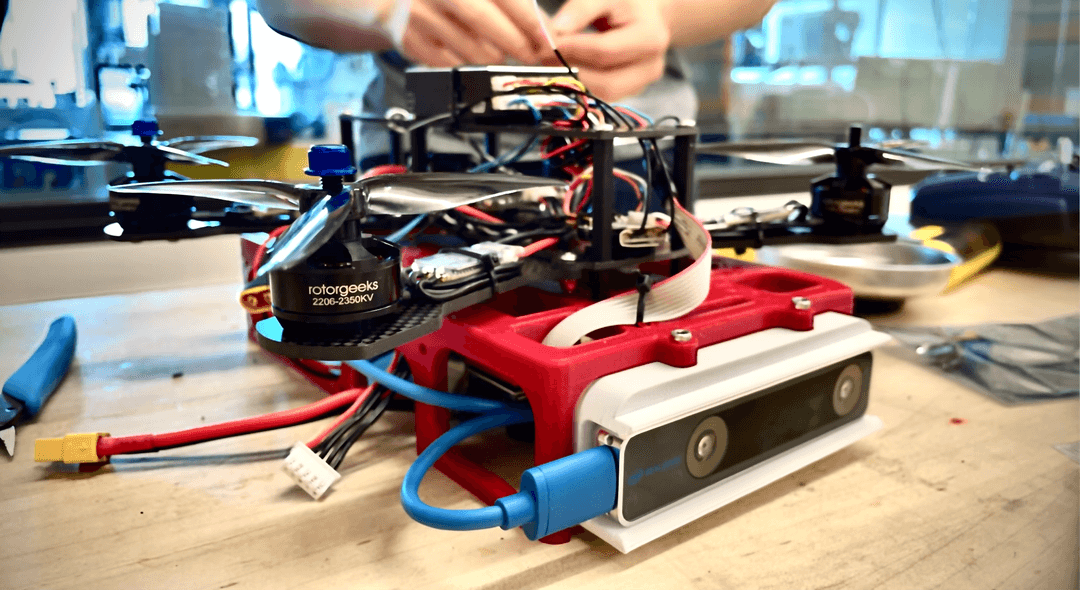
Drones to Ensure Nuclear Plant Safety in an Emergency
For my 4th year Capstone design project teamed with Ben Agro, Jerry Chen, and Connor Lee we designed drones using a wide range of hardware and software tools under the theme of Nuclear Power Plant safety.
Learn More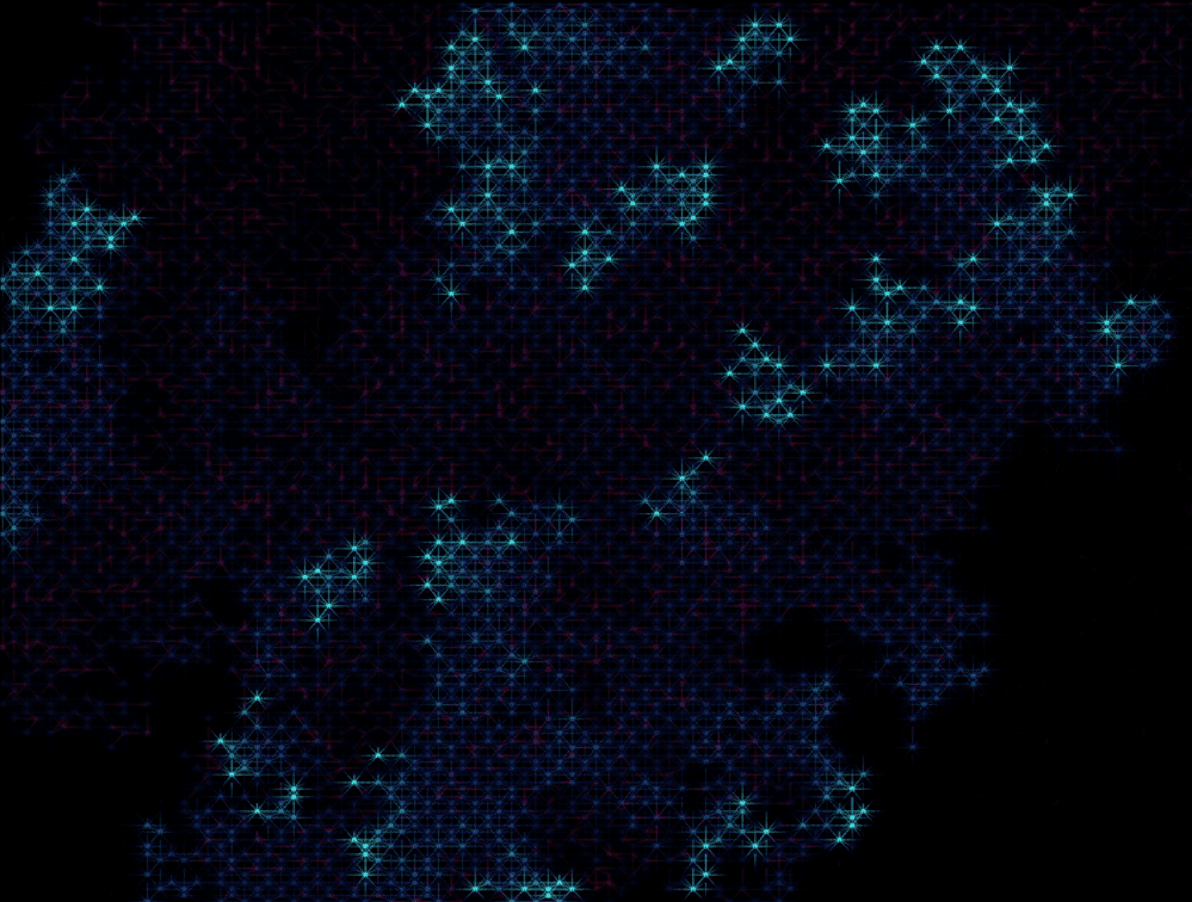

Undergraduate Thesis
Integrating a biological understanding of transcription with an engineering & AI background, I present a novel approach to comprehensively model gene expression using cutting-edge machine learning techniques.

Experimental Data
I collected and preprocessed over 330 million supervised examples sourced from GTEx cell-specific gene expression experiments.

Model Design
I designed a new model for this data taking full advantage of mechanisms known to be important for transcription.

Training & Testing
I trained my model repeatedly, keeping close track of its validation performance in order to optimize its architecture.